Showing posts with label Travelogue. Show all posts

Thursday, April 25, 2019

Of Paradise — Of Kashmir (Conclusion)

The journey to Pahalgam from Gulmarg is about four hours by road. One of the main stops was the one we gave in Anantnag as described in the previous post. There was one more we gave where we visited a store that sold authentic Kashmiri spices, Kesar, etc. and another store which sold the famed Kashmiri Shawls, Pashmina (authentic pashmina shawls are too expensive). 

We had our traditional 'kahwah' for the second or third time - it was prepared in 'Samovar'. Kahwah has more than ten ingredients like almonds, walnuts, saffron, cinnamon, etc.

Samovar

Kahwah
In Anantnag, our driver was conversing with some of the locals and they said that due to the increased snowfall, the vehicle movements were restricted — which meant the to and fro traffic between Kashmir and Jammu will be on alternate days. If this were true, it would definitely disturb our schedule. While the thrill-seeker in me was definitely happy that finally there was some action, I was also worried we may have to miss seeing some places.

Pahalgam was not so famous a few decades ago but of late it has acquired the attention it truly deserved. It's the starting point of the famous Amarnath Yatra. It's one of the most quaint places I've ever seen — untainted, unblemished, raw beauty. It was definitely the highlight of the entire trip.

We met a few shepherds the next morning and talked of the package details.  There are some 6-7 points of interests and two points are not possible to cover in this season of the year because of the deep snow which can be up to 10-12 feet. We were told these points couldn't be covered by ourselves and we had to take ponies. I wondered why — when I had the first glimpse of the terrain we were supposed to cover, it all made sense. 

At a point called mini-Switzerland

To say the terrain was very tough is to belittle the real danger it beholds. The ponies do a great job in a narrow, tough and slippery ground — as one wrong step on a good altitude like this can be really fatal. Your life hinges on the four hooves of a galloping beast — that is indeed intimidating and thrilling at the same time.

Most of the points looked they were straight from some fairy tale; A few of them were touted to be akin to Switzerland — not an unfair comparison at all. It's picturesque, bewitchingly charming. The beauty of Pahalgam is hard to encapsulate in words  it takes your breath away, both metaphorically and literally — it casts a strong spell on you and will take a long time to come out of it - better, you don't want to come out of it. It has to be in your must-see list when you visit Kashmir. It is totally worth it. 

Snowfall in front of our hotel
The next morning we caught the first glimpse of the snowfall and we were ecstatic but the happiness was short-lived as we were told the roadways were all blocked between Kashmir and Jammu due to severe snowfall and the only way available for us was to fly from Srinagar to Jammu. We had to book flights fast; we did book for the next morning for a premium price as there was no way out. 

We left the same day to Srinagar (we were supposed to travel to Katra per original schedule). The travel agents didn't help us in any way for the alternative arrangement. We had to look for the new hotel in Srinagar. Our driver helped us with this  we got a good hotel for a decent price. Since this was near his place, he insisted that we came to his home and had food. We couldn't refuse and we did oblige. 

Our driver cum manager, Ghulam Nabi
Ghulam Nabi's home was on a street not much far from the hotel we stayed in. He had two daughters and two sons. One of the daughters was a chatterbox and really kept us hooked and entertained by her animated talks describing her family and life in general in Srinagar. His son also engaged us with a lot of humor and wit; he had a pro-Pakistani bent and it became apparent after a while. The father and daughter's opinion, in contrast, was neutral. The talks covered life in general, politics, history, the exodus of pandits, etc. Considering there were two ladies in the group, I had decided from the beginning of the trip that I would not give out my opinions which I was sure would get us into trouble. So, I basically listened to whatever they had to spell out.


No matter what opinions they had, their hospitality was top-class. Knowing we were all vegetarians, they took the trouble of going to market, getting paneer and cooking for us. They did not let us go and insisted we have dinner too. Their warmth defeated us and we stayed back for dinner as well. They genuinely showed a lot of care, love, and affection toward us which all of us will cherish for a long time. 

The next morning, we left for Jammu from Srinagar as we bid adieu to Ghulam Nabi. The flight was postponed at least thrice due to bad weather and we reached Katra very late in the evening. We had our flight to Bangalore the next day — that left us very little wiggle room for any change in the plan or relaxation. 

Katra was different — "assalam ul alaikum" was replaced by "Jai Mata Di" everywhere. Jai Mata Di seemed like the ubiquitous word permeating all of Katra. Jammu seemed like more densely populated place than Kashmir. Our new driver was an old Punjabi Sardar who loved to listen to new-school Punjabi Hip-hop. He told us if we have to stick to the schedule and also do darshan of Vaishnodevi, we had no option but to skip sleep that night and start climbing the hill that very night itself.

Ponies here were bigger than those available in Pahalgam
The trek to the peak of the hill is about 12k.m. We took ponies to reach the top and decided to get down by walk. It was uphill and our decision to take ponies to climb instead of going by walk was right. It took some 3 odd hours to reach the top and we could do the darshan of Devi at around 3 a.m. peacefully.

The atmosphere throughout the uphill climb was electrifying, to say the least  many people, younger and the older alike were  climbing the hill which seemed effortless, with "Jai Mata Di" on their lips and steadfast devotion for the divine in their hearts. It's almost a wonder how faith and devotion move people. It can make them do the most beautiful of things in the world that make you feel proud to be human and also on the downside, the most horrific of things that make you squirm in disgust that you are one among the appalling species. 

We stuck to our decision of climbing down the hill by walk. The task at hand was arduous and daunting. Increase in pain with each passing step, deprived sleep made the 12k.m walk a formidable one than it already was — it took five odd hours and a lot of patience, energy to complete the walk. At some point in time, I was so tired that I was dozing off even while walking. It took some grit and a dash of determination to breathe a sigh of relief after reaching the foothills. 

The next day, at the Katra airport we learned that due to heavy snowfall, all the flights flying to and from Srinagar were canceled indefinitely. We thanked our stars as we narrowly escaped being stuck in Srinagar for an indefinite time. We flew back with all those memories we would love to treasure for a long time to come. On the whole, Kashmir is a wonderful place to visit - for the romanticists and adventurers alike - it has something for all. 

Friday, April 19, 2019

Of Paradise — Of Kashmir (Part 2)

The next morning, as per the plan we left for Gulmarg, perhaps the most popular winter sports destination in Kashmir and one of the most popular destinations in India. The snow-clad mountains of inner Himalayas welcomed us - it's an impressive sight.


Even though it was off-season, Gulmarg was pretty much crowded - Amongst all the other places we visited in Kashmir, we found Gulmarg to be most commercialized and most expensive. It hosts an array of activities like Gondola ride, skiing, sledding(sledge-riding), snow-biking, snowboarding, heli-skiing, etc. 

We took the Gondola ride - there are two stages: During summer, as snow wouldn't be easily visible, people go to the second stage. As we went in peak winter, that was not necessary. Hence, we settled for the first stage. For all the snow-activities, you'd need special jackets, boots, etc. which we had taken well before on rent. 


Trying Skiing
We went skiing for some time. I realized it's not as easy as it seems. It takes a while even to adjust to the skiing boots to go a few feets forward. After skiing, we went for sledding - where you sit behind the man in control of the small vehicle called 'sled'. This is for climbing down from the mountain and it is seemingly a little dangerous. At least two of us had a few small injuries but the experience when you climb down is totally worth it. Adrenaline rush guaranteed. 


The next two main destinations remaining were Pahalgam and Katra. It would take just over 4 hours by road from Gulmarg to reach Pahalgam. On the way, we had to pass by Anantnag district. There's the famed Martand Mattan temple dedicated to Sun. It is one among the many temples destroyed by Islamic iconoclast Sikandar Butshikan. What we get to see now is not the original temple but not-so-great reconstruction and ruins.


The entrance of the temple
A lot of CRPF personnel deployed for security
Kashmir was once the center of high learning where refined philosophy of Kashmir Shaivism originated, which gave birth to a polymath like Abhinava Gupta, scholars like Kalhana. But the state in which Kashmir is now is a sad tale.  

That was a digression. In the next and concluding part, we'll visit Pahalgam and then travel to Jammu.

Saturday, April 13, 2019

Of Paradise — Of Kashmir (Part 1)

The mighty white mountains, the fiery chinars, the picturesque landscape convinced me that it's no overstatement to liken Kashmir with paradise. The image of Kashmir that conjures up is perhaps of the valley that is constantly troubled, disturbed, dangerous, which is in a persistent state of embroilment. The imagery is not entirely untrue - but it's only half a story. The other half is known only if you witness it first hand. 

There are a lot of places in India and outside which have fascinated me and kindled my curiosity in multiple ways. If I were to prepare a bucket-list of the same, it would be close to impossible to cover all in one lifetime. Kashmir was not on the list. We decided on Kashmir because of the suggestion from my friend and his wife - it was the coldest season in Kashmir and none of us four had witnessed snowfall made the suggestion all the more appealing.

The semi-frozen Nagin Lake
We visited Kashmir in a season called "Chilai Kalan", starting from December 21 and ending on January 30 - it's regarded as the harshest winter period in the valley. Our itinerary consisted of Srinagar, Gulmarg, Pahalgam, and Katra. We wanted Sonmarg to be added but due to heavy snowfall, it remained closed in the period we traveled. 

It is said that the first mention of Kashmir was in Mahabharata (Sabha Parva to be precise) and Patanjali's Mahabhasya - Kashmira is the name of Goddess Durga/Uma. There's also a version that says the name is from Rishi Kashyapa. But it's not as ancient as Mahabharatha or Mahabhasya. That's a tiny bit of info on the etymology on Kashmir.  

The first stop was in Srinagar and it was for two nights. Since we always wanted to stay in a boathouse, we booked one night in the boathouse and another in a hotel. The chilling weather of -5°C of Srinagar welcomed us. The lowest temperature I had ever seen thus far was 2°C. It was thrilling and equally difficult to go on a boat; as it was challenging to row because of subzero temperature,  most of the lake was transformed into ice. We had our boathouse in Nagin Lake.


We were welcomed to this magnificent view

The next day went into city tour which was quite exhaustive - Shalimar Bagh (Mogul Garden), Hazrat Bal, Shankaracharya Hill, and of course we took the famous Shikhara ride in Dal Lake. Shalimar Bagh or Nishanth bagh would look exquisite during the months of June/July we were told. There are basically two best seasons to visit Kashmir - December, for the fresh snowfall; June, for the valley, will be covered with lush green - that would be a sight to behold. 


Chinar Trees in Mogul Garden


The heavily guarded temple on Shankaracharya Hill - the entrance
We had a fantastic driver cum manager who went by name Ghulam Nabi - who guided us well and helped us to keep the schedule right. The version of Kashmir's history that he gave was interesting and later I found it was a prevailing opinion that a lot of Kashmiris loathed staying either with India or Pakistan for they preferred a separate country. I was to contest this view many times during the similar discussion in the future days of our stay, as I knew it was not accurate - But I detested from airing any opinion. 

Dal Lake
As all of us were vegetarians, we were not sure how good the food will be. Although the vast majority of the food is non-vegetarian as we expected, there were plenty of vegetarian options to our surprise and all were tasty. 

After our two nights stay in Srinagar, it was time to leave for Gulmarg which is around 60 K.M from Srinagar. We said final bye (which was not to be) to Srinagar and left for Gulmarg the next morning. 

Friday, December 29, 2017

In the lands of Cham & Khmer — Part 3 (The conclusion)


The final leg of our trip was to the place that beholds Angkor Wat, Siem Reap. Siem Reap is a small city in the North Western part of Cambodia. It owes its popularity as one of the most popular destinations in the world to Angkor Wat. Angkor Wat and many of the allied temple structures are very much ingrained in the cultural milieu of Cambodia — one of the examples of that would be the fact that it is adorned on the flag of Cambodia.

We came to Siem Reap from Hanoi in VietJet airways. It was a small journey of within 2 hours. The airport of Siem Reap is very small - it should be counted as the smallest airport I've ever been to. Cambodia gives two options for the tourist visa - On arrival and e-visa. We had opted for e-visa. This saved our time at the airport a lot. 

Cambodians are very gentle people. In all our six-day stay, we did not come across a single incident of rudeness or anything of that sort. Perhaps the relatively soft nature of Cambodians has been taken for granted that all three of its neighboring countries — Thailand, Vietnam, and Laos — have tried to invade it at one point or the other. As per our guide for Angkor Wat the next day, Cambodia has a very restricted coastal line because some parts of Cambodia was occupied by Thailand. I'm not sure on the veracity of the claim as when I searched to know the details, google didn't yield any result on the same. 

Almost all the Cambodians I met speak English in Siem Reap. All the stores, hotels and even the small shops accept the US dollar. This was told to me by the Indian-origin Kenyan man I had met in Hanoi. So, I never bothered to exchange the currency to Cambodian Riel. I have to mention the omnipresent Tuk-Tuk. Tuk-Tuk in Cambodia is Indian equivalent of rickshaw but it is pulled by a motorcycle. They are cheap, comfortable and readily available in all of Siem Reap. 

Our tour guide gave many interesting trivia and snippets about Angkor Wat in particular and Cambodia in general. He said Khmer language and Kannada have many words in common. this was a shocker for me. I always knew Cambodia has some Tamil influence as I knew Tamil kings have traveled, ruled and built some of the monuments in this part of the world. But, I never knew this bit about Kannada. He said a few words like Ratri, Rajah, etc are common to both the languages. He said this is because Kannada traders, not kings traveled to Cambodia may be around 14th or 15th century and many of them married the locals and started living there. 

Siem Reap is filled with a lot of tourists. Tourism is one of the major sources of income to Cambodia. From the past many years, the number of tourists has been over a million. I learned that the Angkor Wat temple was abandoned,  attained the state of obscurity 15th century onwards after being the center of the capital of Cambodia from the 9th to 15th century. No one knew of the structures until a Frenchman discovered it in the later parts of the 20th century. It's only in the 90's tourists started pouring in. 

Touted as the world's largest temple, Angkor Wat is truly magnificent. the structure of the main temple is modeled on Mount Meru, the celestial mountain with 5 peaks which is significant to Hindus, Jains, and Buddhists. The temple structure is enclosed by a wide moat which is representative of the cosmic ocean. 


The main temple structure

Apsara Dancer


Carving depicting Mahabharata war
In front of the temple

Behind us is the Adi-Shesha, six-headed serpent structure which is found in many places in Siem Reap town

Once you enter the temple, you can witness the towering structures - some of them intricately carved to depict the scenes of Mahabharata, Apsara dancers, other epics - the detailing and the delicacy employed gives away the fact that it is indeed a work of a lot of skilled artists spanning over several years of time. 

There are other temples around Angkor Wat - Angkor Thom, Bayon, and Ta Prohm. The last one, Ta Prohm was featured in Angelina Julie's movie Tomb Raider. Bayon temple has a lot of Brahma-like big face carvings. (Cambodians say it's King Suryavarman) In Ta Prohm, giant roots have embraced the entire structure. It has been left as it is, uncut. Archaeological Survey of India is involved in restoration work.  


That's a huge root 


Near Bayon temple


The Bayon temple

Our group for the day consisted of us, an English lady, a German mother-daughter duo, the entertaining and informative local guide Phearom, and the rest Malaysians. It was a quite friendly and fun group.


On the way to Angor Thom 


Our group for the day 

The next day, we visited Tonlé Sap lake, perhaps the biggest lake in Cambodia. It is famous for two things - the floating village and the mangrove forest. It was a thrilling experience for me as I had neither seen mangrove forest nor floating village anywhere. I had heard there is a floating market near Saigon. I missed visiting that. This was a kind of compensation. 

Houses elevated to a certain height in the floating village
The Mangrove Forest - reminded of the sets of "Anaconda"
In conclusion: Vietnam is beautiful. When people asked me why 8 days, I had no answer. Now, I can say there is a lot to see in Vietnam & it's still not that popular with Indians say like Thailand or Bali. But it has all the reasons to be. It has something for everyone - the nature lovers, adventure seekers, history buffs, lovers etc.

Angkor Wat stands as testimony to the fact that what a dedicated, patient, creative, skilled above all devoted populace can do. Of course, with exemplary patronage which sustains all, which doesn't think of just immediate survival and sundry but a longlasting legacy of finer achievements for the future generations. If there are seven wonders of the world, this surely needs to be one among them.

Saturday, December 16, 2017

In the lands of Cham & Khmer — Part 2

After a couple of action-packed days in Saigon, we headed to Da Nang. As I mentioned in my previous post, the only reason to include Da Nang in our itinerary was that of its proximity to My Son. But we were surprised that Da Nang had more to offer than what we expected of it.

After seeing the hustle-bustle of Saigon, it was so refreshing to see Da Nang. We reached Da Nang at night, delayed by a couple of hours because of supremely inefficient Jet Star Pacific airlines. Da Nang was dazzling, full of bright colors and sparsely populated hence less traffic as compared to Saigon. We passed by a couple of colorful bridges, whilst on our way to the lodging. The dragon bridge stood out.

The My Khe beach was within half a kilometer from the place where we stayed. We had the best of view from the hotel & it was spectacular. The next morning, we finished the usual buffet breakfast and waited for our tour guide to visit My Son sanctuary. A point to mention about the food - If you are from India, there are high chances that you won't like the food here which is so bland and mostly boiled. Even if you are a non-vegetarian, you may not like the food which is completely deprived of any spices which we Indians are so fond of. That's one compromise which you have to make.


A storm is in the offing

My Khe in the early morning
Our group for the day consisted of mainly Australians and a New Zealand couple. We befriended an old Queensland lady Mary Margaret, who was a great company for us throughout the end of the tour. I had heard, Aussies deride many things. That seemed true when I conversed with her more. Our common despisement of the Chinese endeared her to me more. She talked about various things from politics to policy to investment to culture. Her son is currently in the US and her late husband was working in Sheraton Hotels. She is well read and well traveled (had toured the length and breadth of India and had stayed for 5 months!). She also mentioned she had witnessed the infamous Tienman Square massacre.


Mary and us
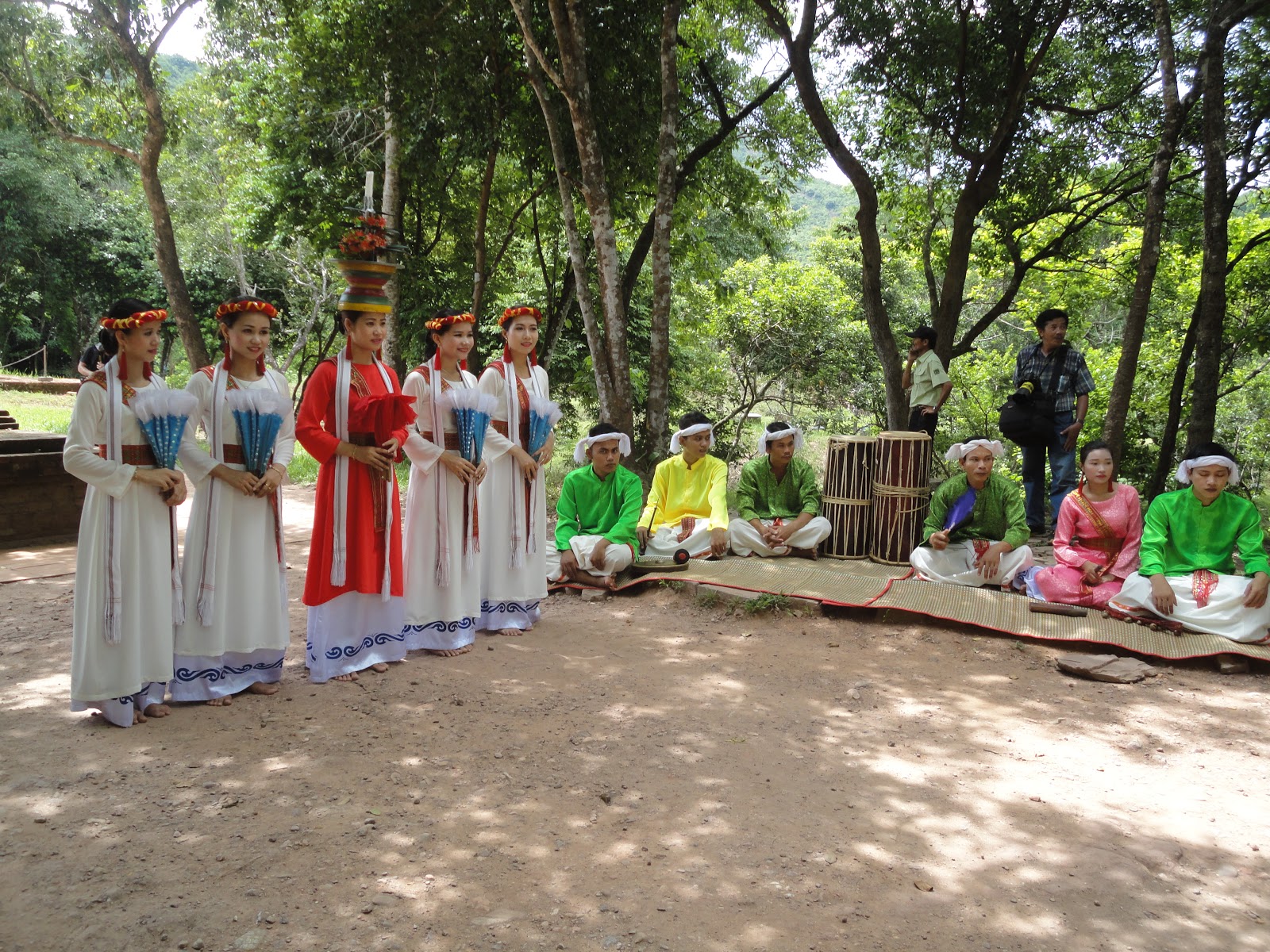
My Son has a very long history. Perhaps one of the longest I've ever known - this dates back to 4th century. I learned that Balamon Cham, the indigenous Hindu population (now just a few thousands in number) is one of a very few groups of people outside India that are still surviving and with a culture dating back thousands of years. The other most prominent group is Hindus of Bali. We were fortunate to witness some of the Balamon Cham people and their performance live.


Entrance to My Son

Balamon Cham troupe

The main temple

The desecrated Shiva Linga


In front of the temple
But sadly to my despair, My Son now looks nowhere magnificent or grand, as most of the temple structure is either abandoned or destroyed by the carpet bombing by the US during its war on Vietnam. It's aptly called now, unfortunately - My Son ruins. Indian government - perhaps in a limited capacity - is involved in its reconstruction & also has donated an amount for the same.


For lunch, we wanted to have Indian food. Fortunately, it was easily available. We went to Maharaja restaurant, run by a Bangalorean man (originally from Delhi). The food was authentic Indian, really yummy and totally worth it. He studied engineering in Bangalore but decided to involve in the hotel business and he said he is doing pretty well. His father is running a restaurant in Tokyo from the last 25 years he said. His father is a Punjabi & mother a Mangalorean. He suggested we visit the cable car of Ba Na Hills. Unfortunately, we didn't have time to complete it. We bid adieu and wished him the best.


Maharaja Restaurant, Da Nang
In my many conversations, what I have observed is the two main groups of people that have gone outside India and doing well are Punjabis and Gujaratis. These are the two groups that have the killer instinct and entrepreneurial spirit. It feels great when you meet your fellow countrymen outside the country and have a conversation with them and listen to their story. 


The next morning, we visited My Khe beach, which was once voted by Forbes as one of the top 10 beaches in the world. My Khe was beautiful, peaceful & less crowded. We couldn't spend more time because there was a storm coming from South China and it started raining non-stop in Da Nang. We left for Hanoi in the noon. 

Hanoi is one of the oldest cities in this part of the world and also one of the densely populated one. Our hotel was in Hàng Bạc area. I felt the locality was kind of similar to old Delhi - small lanes, narrow roads, old buildings, and too many people. Food tours are very famous in Hanoi. Vietnam in general, Hanoi, in particular, has too many eateries - you can find them in every nook and corner. 


The next day we covered too many places of interest - Ho Chi Minh museum, the museum of ethnology, the west lake, Trấn Quốc Pagoda, Confucius temple and many more. We did meet two people of Indian origin in the tour - one lady from Malaysia and one man from Kenya (both are third gen migrants from India). We became friends with a middle-aged sister duo from South Africa - one of them lives in Canada and the other in Botswana. We hit off a good conversation with them as they grew up with Indian families in South Africa and the Indians in South Africa or Botswana are really doing well. 


The West Lake

Temple of Literature

Oldest Pagoda of Hanoi

Lacquer painting
We kept two complete days for Hanoi. The second day was completely dedicated to Halong Bay, which is around 180 km from Hanoi. We had booked for the cruise and lunch. This is the first time we ever went for lunch over the cruise. It was a thrilling experience. The very sight of Halong Bay floors you. It is so beautiful, picturesque. We went in a small boat for some distance after some time. It felt like a Lords of the rings set to me. It was surreal. Halong Bay is worth every penny. 


The Picturesque Halong Bay

One more capture

Inside the cruise
While coming back from Halong Bay to Hanoi, our tour guide talked many interesting points. I'll present it to you as he said - Hanoi is one of the oldest cities which has a history of over 1000 years. the population of Vietnam is about 90 million. Vietnam basically is made of 54 different ethnic groups. Viet is one of the main ethnic group - hence the name Vietnam. China has invaded Vietnam many times & has the border dispute with it (with which of its neighboring country, it doesn't have?!) 


Vietnamese eat almost everything. Some special delicacies would be prepared using - grasshopper, silkworm, rat, dog, cat & snake. The reason for this, he said that there was a severe dearth of food at one point in time. So, Vietnamese for the sake of survival started eating almost everything. Of course, dog meat or cat meat are special and are not available in all restaurants and they are expensive. He narrated an interesting story of an Indonesian man who wanted to try snake meat and he ate the live heart of the snake which was still beating. He turned sick the same night but recovered early morning. When our guide went to bid adieu to him to airport thinking he'll never again visit Vietnam or try such food, he whispered in his ears - "Next time, it's a cat". Our guide was mightily impressed.

In the next concluding post, we'll see Siem Reap and the one & only - Angkor Wat!

Sunday, December 3, 2017

In the lands of Cham & Khmer — Part 1

“Travel is fatal to prejudice, bigotry, and narrow-mindedness, and many of our people need it sorely on these accounts. Broad, wholesome, charitable views of men and things cannot be acquired by vegetating in one little corner of the earth all one's lifetime.” This is what Mark Twain had to say about traveling. No, I didn't travel to acquire charitable view nor I did out of any other noble intention. I just wanted to travel for the sake of it.

One of my primary intentions was to go out of India during my first wedding anniversary in August. I had so many places in my mind. But I was so sure that I wanted to see the Angor Wat temple structures the day I came to know about it. So, considering multiple options, it finally came down to either Australia-New Zealand or Vietnam-Cambodia. I had a budget of two lakhs as the upper limit, and I also wanted the tour to be a little longer and to be adventurous. Vietnam-Cambodia perfectly fitted the bill.

Although our tour was supposed to happen in August, I started planning slowly from February. The only place I knew something about was Angkor Wat of Siem Reap in Cambodia. Thanks to Twitter, I got to know about My Son sanctuary in Vietnam & the Indian connection it has. One of my ambitions has been to visit all the places in the world which are connected to India in one way or the other. So, Angkor Wat and My Son were my foundations in this trip. Hanoi and Ho Chi Minh City (Old name - Saigon) are the two most visited places in Vietnam. I added Da Nang to the list because of its proximity to My Son. Initially I was skeptical, but Da Nang proved to be a magnificent place. I'm glad we visited it. It was four places in total: Saigon, Da Nang, Hanoi & Siem Reap. 

The advantage with this trip (nowadays with all the trips perhaps) was that - all the stages of planning - from flights to hotels to places of visit - can be done online. I did not have to call anyone, nor did I have to take anyone's help. I'm not going to bore you with all the details. But I can tell you one thing. This was my first ever long trip, which I planned completely on my own. I found the process of planning itself so joyful I started enjoying it! You miss this joy and thrill when you go with the travel agent. Yes, some of the places require the help of professionals but some could be done on your own. From my reading and from my limited experience, I think the Asia Pacific can be traveled without any professional guidance

Vietnam


Our first leg of the trip was Vietnam. Most people cover Hanoi, the capital first and then visit Ho Chi Minh City (HCMC). But we did the opposite. It shouldn't matter, really. Hanoi is in North Vietnam and HCMC is in the South. The layover was in Malaysia. I've seen at least 7-8 international airports till now - I think the WiFi of Kaula Lumpur (KL) airport is the best (It helped me kill 4.5 hours so easily). When we boarded the flight from KL, there were almost no Indians in it. HCMC or Vietnam, in general, is not so popular with Indians, yet. But it should be, I'll share the reasons later.

HCMC - The only two things I knew before of the city were - the name Ho Chi Minh, which we all studied in our history books and the equally arresting & disturbing story and the photo alike of Thích Quảng Đức, also known as the burning monk. When we went in the cab and had the first look at the city, it was like any other Indian city with a little more order it seemed. From a Western European or from an American perspective, even this might look chaotic. But for an Indian, nothing will seem chaotic. We might seem a little uncomfortable if there is too much order. After all, India is majestic chaos! Vietnamese use English script for their language as they don't have a script of their own. So, you can read all the boards but can't understand it of course. We took rest the day we reached. We had quite a few places to cover the next and the only complete day we would get in Saigon.


Independence Palace - Saigon


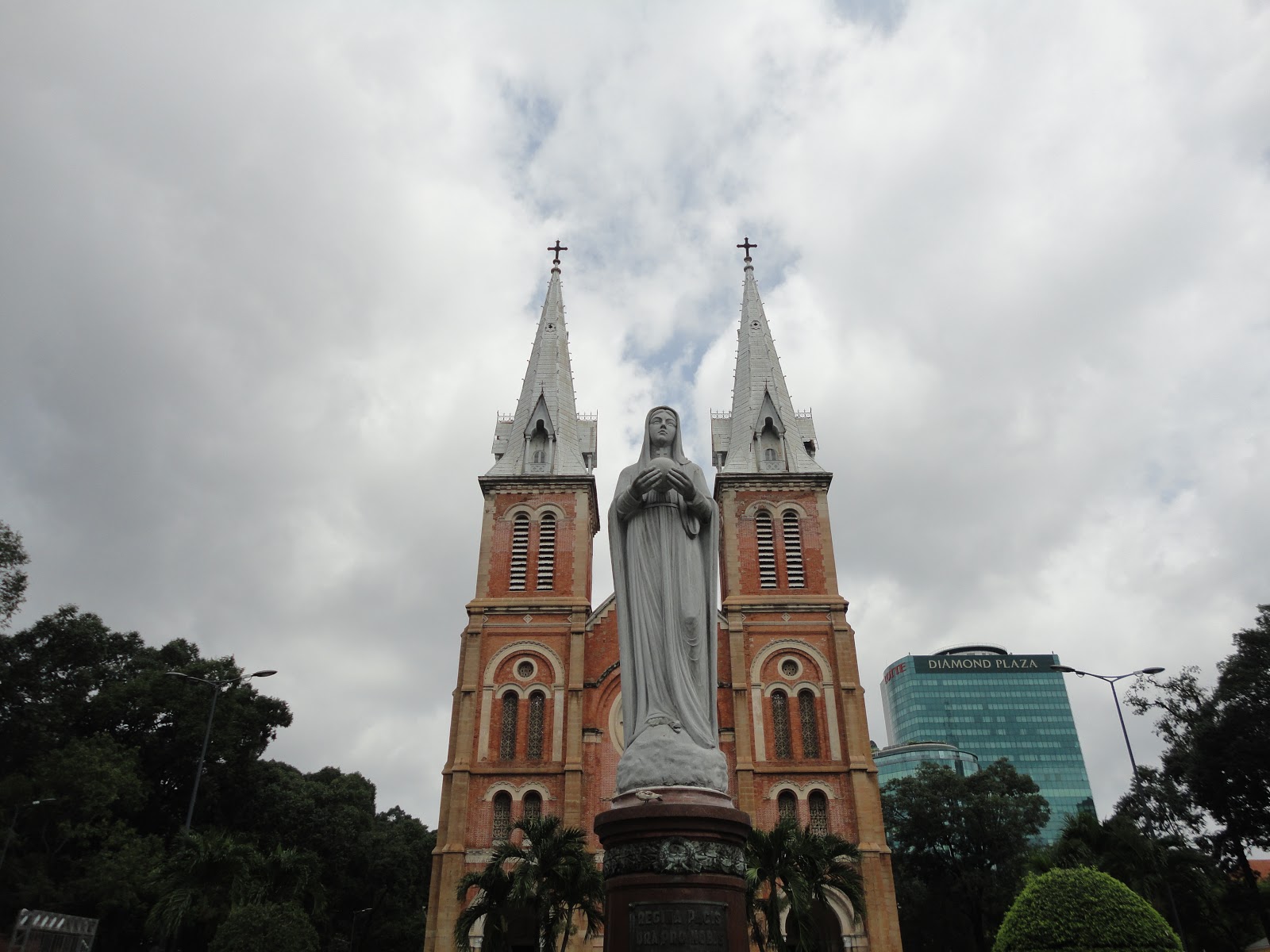
Notre Dame Cathedral

Next day was dedicated to the city tour and the famous Cu Chi tunnels. The city tour mainly consisted of visiting the independence palace, war remnants museum, and the cathedral. A visit to the war remnants museum might make you cringe, might make you an anti-war pacifist - it consists of motley pictures from the US war on Vietnam. Your opinion on the US might undergo a change when you hear specifically on its use of Agent Orange. There are still people who are suffering its devastating effects. We were glad to find an Indian couple (from Gujarat) in the group. They said they have traveled over 40 countries till date!


The Indian couples from Surat, Gujarat


Saigon Post Office


War Remnants Museum


Inside War Remnants Museum


Indian Support to Vietnamese War captured


People affected by Agent Orange

The highlight of the day should be our visit to Cu Chi tunnels. I think it's one of its kind in the world in terms of uniqueness, the difficulty of operation, size and various other factors. These were the tunnels built by Vietcong soldiers during American aggression during the war and were used as a hideout.


One of the staffs demonstrating the hideouts


This is one of the traps 


Inside the bomb-making factory


Entering the tunnel


Snake wine, Scorpion wine...

Our guide for this tour was a young Vietnamese lady who explained us beautifully on all the guerilla warfare techniques used by Vietcong soldiers to dupe and harass the Americans. The tenacity and the never-say-die spirit that they have displayed should be a lesson in patriotism. We too should take a figleaf from their pages of history. 

In the next posts, I will tell you about Da Nang, My Son, Hanoi & Siem Reap.

....to be continued