Showing posts with label Angor Wat. Show all posts

Friday, December 29, 2017

In the lands of Cham & Khmer — Part 3 (The conclusion)


The final leg of our trip was to the place that beholds Angkor Wat, Siem Reap. Siem Reap is a small city in the North Western part of Cambodia. It owes its popularity as one of the most popular destinations in the world to Angkor Wat. Angkor Wat and many of the allied temple structures are very much ingrained in the cultural milieu of Cambodia — one of the examples of that would be the fact that it is adorned on the flag of Cambodia.

We came to Siem Reap from Hanoi in VietJet airways. It was a small journey of within 2 hours. The airport of Siem Reap is very small - it should be counted as the smallest airport I've ever been to. Cambodia gives two options for the tourist visa - On arrival and e-visa. We had opted for e-visa. This saved our time at the airport a lot. 

Cambodians are very gentle people. In all our six-day stay, we did not come across a single incident of rudeness or anything of that sort. Perhaps the relatively soft nature of Cambodians has been taken for granted that all three of its neighboring countries — Thailand, Vietnam, and Laos — have tried to invade it at one point or the other. As per our guide for Angkor Wat the next day, Cambodia has a very restricted coastal line because some parts of Cambodia was occupied by Thailand. I'm not sure on the veracity of the claim as when I searched to know the details, google didn't yield any result on the same. 

Almost all the Cambodians I met speak English in Siem Reap. All the stores, hotels and even the small shops accept the US dollar. This was told to me by the Indian-origin Kenyan man I had met in Hanoi. So, I never bothered to exchange the currency to Cambodian Riel. I have to mention the omnipresent Tuk-Tuk. Tuk-Tuk in Cambodia is Indian equivalent of rickshaw but it is pulled by a motorcycle. They are cheap, comfortable and readily available in all of Siem Reap. 

Our tour guide gave many interesting trivia and snippets about Angkor Wat in particular and Cambodia in general. He said Khmer language and Kannada have many words in common. this was a shocker for me. I always knew Cambodia has some Tamil influence as I knew Tamil kings have traveled, ruled and built some of the monuments in this part of the world. But, I never knew this bit about Kannada. He said a few words like Ratri, Rajah, etc are common to both the languages. He said this is because Kannada traders, not kings traveled to Cambodia may be around 14th or 15th century and many of them married the locals and started living there. 

Siem Reap is filled with a lot of tourists. Tourism is one of the major sources of income to Cambodia. From the past many years, the number of tourists has been over a million. I learned that the Angkor Wat temple was abandoned,  attained the state of obscurity 15th century onwards after being the center of the capital of Cambodia from the 9th to 15th century. No one knew of the structures until a Frenchman discovered it in the later parts of the 20th century. It's only in the 90's tourists started pouring in. 

Touted as the world's largest temple, Angkor Wat is truly magnificent. the structure of the main temple is modeled on Mount Meru, the celestial mountain with 5 peaks which is significant to Hindus, Jains, and Buddhists. The temple structure is enclosed by a wide moat which is representative of the cosmic ocean. 


The main temple structure

Apsara Dancer


Carving depicting Mahabharata war
In front of the temple

Behind us is the Adi-Shesha, six-headed serpent structure which is found in many places in Siem Reap town

Once you enter the temple, you can witness the towering structures - some of them intricately carved to depict the scenes of Mahabharata, Apsara dancers, other epics - the detailing and the delicacy employed gives away the fact that it is indeed a work of a lot of skilled artists spanning over several years of time. 

There are other temples around Angkor Wat - Angkor Thom, Bayon, and Ta Prohm. The last one, Ta Prohm was featured in Angelina Julie's movie Tomb Raider. Bayon temple has a lot of Brahma-like big face carvings. (Cambodians say it's King Suryavarman) In Ta Prohm, giant roots have embraced the entire structure. It has been left as it is, uncut. Archaeological Survey of India is involved in restoration work.  


That's a huge root 


Near Bayon temple


The Bayon temple

Our group for the day consisted of us, an English lady, a German mother-daughter duo, the entertaining and informative local guide Phearom, and the rest Malaysians. It was a quite friendly and fun group.


On the way to Angor Thom 


Our group for the day 

The next day, we visited Tonlé Sap lake, perhaps the biggest lake in Cambodia. It is famous for two things - the floating village and the mangrove forest. It was a thrilling experience for me as I had neither seen mangrove forest nor floating village anywhere. I had heard there is a floating market near Saigon. I missed visiting that. This was a kind of compensation. 

Houses elevated to a certain height in the floating village
The Mangrove Forest - reminded of the sets of "Anaconda"
In conclusion: Vietnam is beautiful. When people asked me why 8 days, I had no answer. Now, I can say there is a lot to see in Vietnam & it's still not that popular with Indians say like Thailand or Bali. But it has all the reasons to be. It has something for everyone - the nature lovers, adventure seekers, history buffs, lovers etc.

Angkor Wat stands as testimony to the fact that what a dedicated, patient, creative, skilled above all devoted populace can do. Of course, with exemplary patronage which sustains all, which doesn't think of just immediate survival and sundry but a longlasting legacy of finer achievements for the future generations. If there are seven wonders of the world, this surely needs to be one among them.

Sunday, December 3, 2017

In the lands of Cham & Khmer — Part 1

“Travel is fatal to prejudice, bigotry, and narrow-mindedness, and many of our people need it sorely on these accounts. Broad, wholesome, charitable views of men and things cannot be acquired by vegetating in one little corner of the earth all one's lifetime.” This is what Mark Twain had to say about traveling. No, I didn't travel to acquire charitable view nor I did out of any other noble intention. I just wanted to travel for the sake of it.

One of my primary intentions was to go out of India during my first wedding anniversary in August. I had so many places in my mind. But I was so sure that I wanted to see the Angor Wat temple structures the day I came to know about it. So, considering multiple options, it finally came down to either Australia-New Zealand or Vietnam-Cambodia. I had a budget of two lakhs as the upper limit, and I also wanted the tour to be a little longer and to be adventurous. Vietnam-Cambodia perfectly fitted the bill.

Although our tour was supposed to happen in August, I started planning slowly from February. The only place I knew something about was Angkor Wat of Siem Reap in Cambodia. Thanks to Twitter, I got to know about My Son sanctuary in Vietnam & the Indian connection it has. One of my ambitions has been to visit all the places in the world which are connected to India in one way or the other. So, Angkor Wat and My Son were my foundations in this trip. Hanoi and Ho Chi Minh City (Old name - Saigon) are the two most visited places in Vietnam. I added Da Nang to the list because of its proximity to My Son. Initially I was skeptical, but Da Nang proved to be a magnificent place. I'm glad we visited it. It was four places in total: Saigon, Da Nang, Hanoi & Siem Reap. 

The advantage with this trip (nowadays with all the trips perhaps) was that - all the stages of planning - from flights to hotels to places of visit - can be done online. I did not have to call anyone, nor did I have to take anyone's help. I'm not going to bore you with all the details. But I can tell you one thing. This was my first ever long trip, which I planned completely on my own. I found the process of planning itself so joyful I started enjoying it! You miss this joy and thrill when you go with the travel agent. Yes, some of the places require the help of professionals but some could be done on your own. From my reading and from my limited experience, I think the Asia Pacific can be traveled without any professional guidance

Vietnam


Our first leg of the trip was Vietnam. Most people cover Hanoi, the capital first and then visit Ho Chi Minh City (HCMC). But we did the opposite. It shouldn't matter, really. Hanoi is in North Vietnam and HCMC is in the South. The layover was in Malaysia. I've seen at least 7-8 international airports till now - I think the WiFi of Kaula Lumpur (KL) airport is the best (It helped me kill 4.5 hours so easily). When we boarded the flight from KL, there were almost no Indians in it. HCMC or Vietnam, in general, is not so popular with Indians, yet. But it should be, I'll share the reasons later.

HCMC - The only two things I knew before of the city were - the name Ho Chi Minh, which we all studied in our history books and the equally arresting & disturbing story and the photo alike of Thích Quảng Đức, also known as the burning monk. When we went in the cab and had the first look at the city, it was like any other Indian city with a little more order it seemed. From a Western European or from an American perspective, even this might look chaotic. But for an Indian, nothing will seem chaotic. We might seem a little uncomfortable if there is too much order. After all, India is majestic chaos! Vietnamese use English script for their language as they don't have a script of their own. So, you can read all the boards but can't understand it of course. We took rest the day we reached. We had quite a few places to cover the next and the only complete day we would get in Saigon.


Independence Palace - Saigon


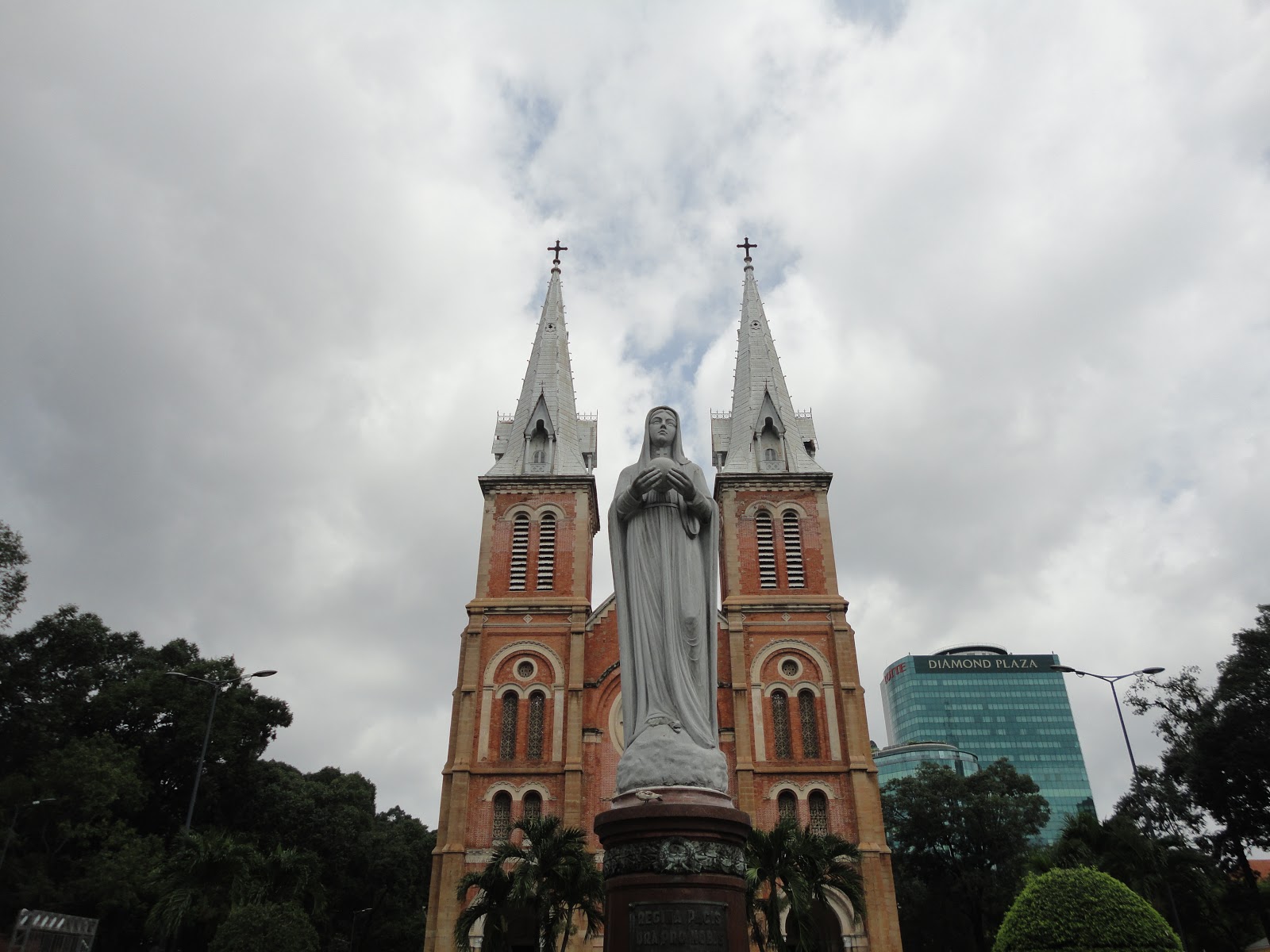
Notre Dame Cathedral

Next day was dedicated to the city tour and the famous Cu Chi tunnels. The city tour mainly consisted of visiting the independence palace, war remnants museum, and the cathedral. A visit to the war remnants museum might make you cringe, might make you an anti-war pacifist - it consists of motley pictures from the US war on Vietnam. Your opinion on the US might undergo a change when you hear specifically on its use of Agent Orange. There are still people who are suffering its devastating effects. We were glad to find an Indian couple (from Gujarat) in the group. They said they have traveled over 40 countries till date!


The Indian couples from Surat, Gujarat


Saigon Post Office


War Remnants Museum


Inside War Remnants Museum


Indian Support to Vietnamese War captured


People affected by Agent Orange

The highlight of the day should be our visit to Cu Chi tunnels. I think it's one of its kind in the world in terms of uniqueness, the difficulty of operation, size and various other factors. These were the tunnels built by Vietcong soldiers during American aggression during the war and were used as a hideout.


One of the staffs demonstrating the hideouts


This is one of the traps 


Inside the bomb-making factory


Entering the tunnel


Snake wine, Scorpion wine...

Our guide for this tour was a young Vietnamese lady who explained us beautifully on all the guerilla warfare techniques used by Vietcong soldiers to dupe and harass the Americans. The tenacity and the never-say-die spirit that they have displayed should be a lesson in patriotism. We too should take a figleaf from their pages of history. 

In the next posts, I will tell you about Da Nang, My Son, Hanoi & Siem Reap.

....to be continued