Saturday, February 28, 2026

The Alchemy of Sacrifice

Sacrifice is usually described as subtraction: less sleep, less comfort, more hours worked. That framing misses the mechanism that actually changes outcomes. In practice, sacrifice alters structure. It is the decision to make parts of your current self-i.e., your habits, incentives, and identity stop fitting the environment you are trying to operate in.

Effort attracts most of the attention: work longer, push harder, stay disciplined. Effort matters but it compounds poorly on the wrong structure. If your routines and incentives are tuned for yesterday’s conditions, extra effort just reinforces yesterday’s results. You become more efficient at staying the same.

This is why some highly disciplined people stall. They extend their hours while leaving their assumptions untouched. They refine routines while keeping the same identity constraints. From a distance it reads as persistence. Up close it is optimization inside a narrowing box.

Working harder within the same framework is like decorating a cage. It makes the prison more comfortable, but it remains a prison. Real transformation requires abandoning the very tools we believe will get us there. Sacrifice is walking away from your own applause. It’s choosing the path where nobody recognizes you—where your skills become less useful and your identity becomes a liability rather than an asset. Most people never sacrifice because they cannot bear the temporary state of being nobody.

Our ancient texts understood this differently. The Isha Upanishad declares that all pleasures should be enjoyed with a feeling of renunciation. This isn’t about denying pleasure—it’s about refusing to be owned by it. When we work without ego and attachment, it becomes “a pleasurable sacrifice”: selfless work that is its own reward.

The Bhagavad Gita speaks of sacrifice through action: “Whatever you do, or eat, or sacrifice, or give… offer unto Me.” But this offering isn’t to some external deity—it’s an offering of your relationship with your own actions. Another verse states: “He who performs actions dedicating them to the Lord and giving up attachment is untainted by sin, as a lotus leaf by water.” The leaf doesn’t become the water; it remains itself because it has surrendered its relationship to it.

The harder form of sacrifice involves discarding versions of yourself that once worked. That move is psychologically expensive because past competence feels like permanent guidance. But it often functions as inertia.

Most people stay small because they refuse to let the current self go. They cling to an identity that once felt safe: the reliable student, the steady employee, the person who follows the expected timeline. Refusing to break from that script is presented as maturity or responsibility. In truth, it is loyalty to a past version that no longer fits.

Living in the Past feels like Nostalgia but it's actually a Strategy

The past is seductive because it is known. Norms are the fossilized choices of previous generations—they record what once had to be risked, then harden into “how things are done.” Following them feels like wisdom. It is fear wearing tradition’s clothing.

Norms reinforce the same pattern. Systems reward predictability because predictable people are easier to coordinate. Those who stay within familiar patterns remain legible to employers, peers, and institutions. Over time, legibility starts to look like prudence.

But norms also lag. They summarize what worked for many people in the recent past. When conditions shift, be it technology, markets or incentives, the summary remains long after the environment has moved. Following it continues to feel safe even as the payoff declines.

People who move materially beyond their cohort usually cross at least one boundary that previously defined them: role, geography, peer group, compensation model, or personal narrativeGreatness requires refusing the already-written life. It demands accepting the disorientation that arrives when no existing map applies. The people who remain small are not necessarily lazy. But they are loyal to an earlier self, an earlier story, an identity that once protected them. Loyalty to a past self is the most expensive form of nostalgia.

Those who cross into rarer territory understand something simpler: the self is not a monument to preserve. It is material to be consumed. Every real advance requires burning something once believed essential—certainty, approval, belonging, the comfort of being right about who you are.

The Kaivalya Upanishad states it plainly: “Not by actions, nor by progeny, nor by wealth—by renunciation alone do some attain immortality.” Sacrifice, seen clearly, is ruthless self-revision. It is agreeing to become unrecognizable to yesterday’s version, so tomorrow’s version has space to exist.

Sacrifice functions as an alignment tool. When comfort, identity, and inherited norms start anchoring you to conditions that no longer reward the same behaviors, extra effort inside the existing frame delivers less. Adjusting the frame changes the payoff surface.

Comfort Is Where Things Stop Moving

Comfort is often decay in disguise. We treat it as the reward after hard work—but it’s usually a trap. Once you’re comfortable, you stop adapting. Stop adapting long enough, and you calcify. You wake up one day and realize you’ve been running the same routines, having the same arguments, thinking the same thoughts for years. This happens when you optimize for comfort instead of staying sharp.

Comfort also blocks change. Anyone who refuses to outgrow yesterday’s self cannot become tomorrow’s possibility. Look at the people we admire and study. Einstein left the safe patent-office routine and abandoned the Newtonian framework that had defined physics for generations. Both the comfortable clerk role and the mechanistic worldview had to be discarded for relativity to appear.

Jobs repeatedly abandoned earlier versions of himself—polite college conformity, corporate career tracks, even aspects of his own spiritual practice—when they no longer served the next stage of his vision. 

It’s the same pattern with Soros and Musk, and it repeats across fields. A scientist leaves tenure to chase an unproven hypothesis. A writer discards a praised manuscript because it no longer matches the voice inside. An entrepreneur walks away from a lucrative exit because staying would mean remaining limited.

Greatness tends to happen when you walk away from security before it becomes stagnation. When you quit the job that’s “fine.” When you end relationships that aren’t bad but aren’t catalyzing anything. When you kill the version of yourself that everyone likes but that you’ve quietly outgrown.

There’s a concept in Vedantic tradition called sannyasa—renunciation. Not the renunciation of old age or forced retreat, but the deliberate choice to walk away from what’s working because it works. Clinging to comfort, even justified comfort, makes you brittle. You become the role. You become the accumulation. Sannyasa is the recognition that staying too long in any form—even a successful one—is its own kind of death.

Identity Is Debt to Your Past Self

Identity is backward-looking by design. It’s built from old decisions, relationships, wins and losses. It’s the thread connecting who you were to who you are. We cling to it because it gives us continuity.

The person you were five years ago made decisions based on constraints that no longer apply. That person had specific fears and blind spots. If you’re still operating from that playbook, you’re outdated. Identity becomes debt when it stops you from changing. When you say “that’s not who I am,” you usually mean “that’s not who I was, and I’m afraid to let that person go.” You don’t necessarily owe loyalty to expired versions of yourself.

Sacrifice here means refusing to honor sunk costs. "I was that. I’m not anymore. I won’t drag my former self into my future just because people expect continuity." 

This makes transformation lonely. You’re leaving behind the you that people knew—the you that you knew. There’s no guarantee the next version will be better, only that it will be different.

This is why few go through with it. The obstacle isn’t effort—it’s the terror of becoming unfamiliar to yourself. Humans will tolerate stagnation, even misery, before they risk incoherence. Most people struggle with that level of uncertainty.

Complacency Doesn’t Announce Itself

Complacency shows up as satisfaction—thinking things are “good enough,” believing the hard part is over and you can coast. That’s often the beginning of the end. Complacency is agreeing to mediocrity in a calm voice. It’s deciding to stop reaching, stop risking, stop evolving.

Complacent people often work very hard. They show up, execute, deliver. But they’re operating inside a framework they’ve already mastered. There’s no real uncertainty, no risk of looking incompetent. They’ve traded growth for competence. When competence becomes the ceiling, it’s usually just a polite word for stuck.

Greatness tends to require refusing to settle—refusing to accept that this life, this work, this version of yourself is the final draft. It requires a constant, uncomfortable awareness that you could be more if you were willing to give up the safety of what you already are.

Most people won’t. They plateau and call it maturity. They call it being realistic.

What Sacrifice Actually Looks Like

Real sacrifice means shedding the parts of you that hold you back. Leaving the career that gave you status but no energy. Ending relationships that are pleasant but not generative. Abandoning beliefs you inherited without examining. Walking away from an identity people admire because you’ve outgrown it.

The Upanishads call this neti neti—“not this, not this.” It’s a method of negation. You don’t find yourself by adding more identities. You find yourself by stripping away the false ones. This feels like death because, in some sense, it is.

There’s no guarantee what comes next will work. You might fail. You might be misunderstood. You might lose people who can’t follow you into new territory.

The alternative: stay. Preserve. Maintain. Live as a monument to who you used to be. Most people choose the monument. It’s safer. It’s explainable. But it’s rarely alive.

The Only Question

Sacrifice is about what you’re willing to become. Are you willing to be unrecognizable to people who thought they knew you? Are you willing to leave comfort when it starts feeling like a cage? Are you willing to burn an identity you spent years building if it no longer fits?

Most people say no. They work harder instead. They optimize the existing game. They add more without removing anything, then wonder why they feel stuck.

Working harder within your existing framework only amplifies what’s already there. Sacrifice destroys the framework. It means accepting that the version of you who got you here might be the very thing blocking what comes next.

You aren’t refining your old character. You are breaking it into raw materials: attention, desire, the capacity to endure uncertainty. From these, a different person can form—more capable, able to engage reality as it is.

This explains why significant breakthroughs are rare. The bottleneck is seldom effort or intelligence. It is the willingness to endure this specific, personal unmasking. Most people prefer a complete, small self to an incomplete, expanding possibility.

The outcome isn’t happiness or acclaim. It is agency. You are no longer governed by your biography or your culture’s expectations. The past becomes information, not instruction. Norms become observations, not commands.

There’s no glory in this. Often there’s only doubt and second-guessing. But what emerges isn’t the product of willpower. It’s what remains after you stop defending an outdated self.

Greatness doesn’t come from pushing harder. It comes from letting go—of the narrative, the reputation, the need to remain recognizable—so something else can take shape.

Monday, February 9, 2026

The Structure of Drift - A Personal Reflection

In Śānti Parva of Mahābhārata, Kuru patriarch Bhīṣma lies upon a bed of arrows, imparting final counsel to the victorious but shattered Yudhiṣṭhira. This single verse surfaces with the force of a timeless truth: Two logs float on the surface of a great ocean. Moved by currents they do not control, they drift together for a time, touch, and then separate.

यथा काष्ठं च काष्ठं च समेयातां महोदधौ।
समेत्य च व्यतीयातां तद्वत् भूतः समागमः॥

The literal meaning is: “As two logs of wood floating on the great ocean come together and, after meeting, drift apart again, so is the meeting of living beings in this world.” The verse does not interpret the meeting or justify the parting. It records the movement and moves on.

The force of the image lies in its restraint. The meeting is not elevated into something exceptional, nor is the separation treated as a disruption. The ocean continues, the currents persist. Coming together happens when conditions allow. Drifting apart follows by the same logic, both belong to the same structure.

There were people in my life who once felt inseparable, almost familial, and who later drifted away as if that shared past had left no residue. For a long time, I couldn’t make sense of it. Perhaps I carried an unresolved bitterness, less about their leaving than about the apparent ease with which it happened. Encountering this way of seeing i.e. as described in 
Śānti Parva helped me in reframing it. The departure no longer felt like a negation of what had been, but it felt like its completion. That shift brought a softer regard for those who moved on, and a calmer kind of peace for myself.

Impermanence is treated in this verse as a premise rather than a conclusion. The Mahābhārata does not present transience as a problem waiting for resolution. It treats it as the ground on which life unfolds. Attention is drawn to motion but not to disappearance. 

Indic thought returns to this recognition without softening it. Forms arise and dissolve. Relationships gather and scatter. Time does not preserve what has occurred. In the Śānti Parva, this understanding is voiced amid aftermath—after war, after death, after events that cannot be reversed. It is spoken from within consequence, not from a position of withdrawal.

This movement does not halt at the horizon of human affairs. In the Indic treatment of Cosmology, even universes follow this movement - arise, endure for some time, and finally dissolve. Transience is an underlying pattern by which the very existence expresses itself at every scale. As Bhagavad Gītā simply put it: 
 
सर्वभूतानि कौल्‍येऽस्य प्रभवत्यहरागमे।
रात्र्यागमे प्रलीयन्ते तत्रैवाव्यक्तसंज्ञके॥

“O son of Kunti, at the coming of day all beings manifest from the unmanifest, and at the coming of night they again dissolve into that very unmanifest.”

Seen from this vantage point, relationships resemble meetings rather than holdings. They occur when trajectories cross. Their reality lies in presence rather than duration. The pain of separation does not negate the meeting. It reveals an expectation that the meeting should have remained unchanged. The verse releases that expectation.

The following may appear to be an exercise in optimization, but the intent is slightly different. Also, it needs to be said in this context as it's an overlooked truth: Because time and energy are finite, attention cannot help but be selective. It settles where conditions allow, lingers for a while, then shifts. What matters is not that attention is “valuable,” but that it is transient, and therefore cannot be given everywhere or indefinitely.

When the logs separate, they do not resume the course they would have taken had they never met. The encounter alters their direction, however slightly. Drift continues, but from a different orientation. The meeting leaves a trace without needing to last.

In the Mahābhārata, responsibility does not depend on outcomes remaining intact. Actions are undertaken even when continuity cannot be secured. Bonds are honored without claims of possession. What persists is not the arrangement itself, but the order within which arrangements arise and pass.

Non-attachment, understood in this context, does reflect accuracy. When transience is seen clearly, engagement becomes unburdened by expectations the structure cannot sustain. Action continues within impermanence rather than against it.

Loss appears as part of the same movement that made connection possible. The verse does not instruct or console. It offers orientation. Life appears less as a sequence of acquisitions and forfeitures and more as a series of crossings within a larger flow. Meaning does not vanish under this view but instead shifts location, resting in participation rather than preservation.

The logs do not resist the ocean, nor do they attempt to fix their meeting into permanence. They move within a system that continues regardless of their contact. In that movement, connection and separation no longer appear as opposites. They register as phases of the same passage, carried forward by currents that do not pause and do not erase.

Friday, January 9, 2026

The Law of Biggest Stick - How Scale Determines Justice

Back in 1989, the United States marched into Panama, grabbed President Manuel Noriega on drug charges, and flew him straight to Miami for trial. More than 500 Panamanian civilians died. Whole neighbourhoods were flattened. The Panama Canal remained securely in American hands. And what did they call this? Conquest? “Operation Just Cause” – a law enforcement action. 

That’s the template. Abduction becomes extradition. Bombing becomes precision justice. Occupation becomes “temporary stewardship”. Fast forward to January 3, 2026. The United States runs the exact same play in Caracas. They strike the capital, snatch President Nicolás Maduro and his wife, and announce they’ll “run the country” until a “proper transition”. Within 48 hours Maduro is in a Miami courtroom facing drug charges. Donald Trump beams: “One of the most stunning displays of American military might in history.” 

They didn’t call it an invasion. They called it an arrest. 

While American forces were busy seizing a foreign capital, a small trader in India was getting raided and slapped with penalties for a few thousand rupees of tax discrepancy. One is hailed as justice. The other is branded evasion. The act is the same – withholding something that belongs to a governing authority. The difference is scale, and who has the power to write the story. 

The Legitimacy Test

If an ordinary Venezuelan had bombed government buildings in Caracas, kidnapped the president and declared he would run things for a while – what would we call him? Terrorist. Criminal. Insurgent. 

When the United States does exactly the same thing, we’re having a “debate” about whether it’s justified. That gap – that glaring double standard – is where real legitimacy lives. It’s not about morality. It’s about power. As Thucydides put it over two thousand years ago in the Melian Dialogue: “the strong do what they can and the weak suffer what they must.” Venezuela 2026 is just the latest chapter. 

The same logic plays out with taxes. A salaried employee who under-reports ₹50,000 faces raids, penalties, potential prosecution. A corporation that shifts ₹500 crore offshore gets negotiation, settlements, amnesty schemes. Both withheld money from the state. Scale decides which one is treated as a criminal and which one is treated as “complexity” that deserves dialogue. 


How Scale Manufactures Legitimacy 

This pattern is ancient and repeats with remarkable consistency.

Territorial annexation follows a script, more or less: The U.S. starts a war over a disputed border with Mexico (1846) and walks away with 55% of its territory. Today we call it “westward expansion”. China takes Tibet (1951), framing it as liberating serfs from feudalism. Today it’s an “autonomous region” and any resistance is “separatism”. Both won. Both integrated the land. Both wrote the history books.

Regime change operates similarly: The U.S. invades Iraq (2003) on fabricated WMD claims, kills hundreds of thousands, dismantles the state. Two decades later it’s remembered as an “intelligence failure”, a “mistake” – not the crime of aggression it legally was. The U.S. had enough power to outlast the outrage until the narrative shifted from crime to costly error. 

Gradual encroachment succeeds through fait accompli: China builds and militarizes islands in disputed waters, ignoring an international tribunal ruling (2016), and keeps going. At home it’s “defending sovereign rights”. Abroad there are protests, some sanctions talk, but no real military pushback. If you’re strong enough to finish the job and ride out the criticism, the new reality sticks. 

In December 2024, President-elect Trump declared that acquiring Greenland was an “absolute necessity” for U.S. national security — citing rare-earth minerals and Arctic positioning. When Denmark refused to even discuss selling its autonomous territory, Trump declined to rule out “other options,” hinting at military or economic coercion.

By January 2025, his son was on a “private visit” to Greenland while officials in Washington floated tariff threats to “get Denmark’s attention.” That same month, new noises came out of the White House: talk of “reclaiming” the Panama Canal, pressure on Canada about “51st-state” integration, and tariff ultimatums to Colombia, Cuba, and others across Latin America over migration and trade.

A NATO ally, a major trading partner, and an entire region learned the same lesson: when a superpower wants something you control, alliance and sovereignty become negotiable. The method differed from Venezuela — economic pressure instead of airstrikes — but the logic was identical: strategic value justifies bending the rules, and scale decides who gets to enforce their will.

Russia tried the same in Crimea and faced sustained sanctions – they didn’t have enough economic or narrative muscle to make the world shrug and move on. The U.S. faced no such price for Iraq. Legitimacy isn’t earned through virtue. It’s manufactured through power, control of the story, and time. 

But narrative control isn’t absolute anymore. NGOs, independent media, social media, grassroots voices – they fight back in real time. Colonial powers could take generations to cement their story because information was tightly controlled. Today, powerful states have to manufacture legitimacy much faster and against far more resistance.

The Asymmetry of Law 

International law operates as a power hierarchy, not a neutral system. There’s no impartial judge, no equal enforcement. The Rome Statute goes after African warlords and Balkan strongmen, but has never touched an American president, a Chinese premier, or a Russian leader. Not because they’re innocent – because they can simply ignore the court. 

US Senator Mark Warner put it bluntly: “Does this mean any large country can indict the ruler of a smaller adjacent country and take that person out?” The answer is yes – if they’re strong enough to get away with it. 

Just like tax authorities will happily crush a small trader over minor discrepancies but approach corporations hiding hundreds of crores with negotiation and dialogue. Enforcement follows the path of least resistance – which always means it falls hardest on those who can’t push back. 

Other powers are watching. China can point to Venezuela to justify moves on Taiwan. Russia already uses U.S. interventions to excuse actions in Ukraine. This is the logical outcome when sovereignty stops being a real principle and becomes a privilege of the powerful. 

The Humanitarian Exception Alibi

Could Venezuela be justified on humanitarian grounds – alleviating suffering under Maduro’s brutal regime? Perhaps, if we believed the rationale. But the U.S. happily props up equally brutal governments when it suits them: Saudi Arabia (journalist dismembered, mass executions), Egypt (tens of thousands of political prisoners), UAE (opposition criminalized). Humanitarian concern appears only when it’s strategically convenient. 

If the goal was really the well-being of Venezuelans, there were other options: sustained diplomatic pressure, targeted sanctions on regime leadership, support for internal opposition. The bombing-then-governing route reveals the actual priority: control of resources, influence, and regional dominance. When humanitarian claims are applied this selectively, they stop being principles and become just another weapon in the arsenal. Scale decides which suffering is worth bombing over. 

The Historical Trajectory 

Empires have always worked this way. The British “administered” India rather than “conquering” it. The Spanish “civilized” indigenous peoples rather than massacring them. The framing shifted only when the power relationship changed.

What’s different now is the speed and the contestation. Colonial legitimacy could be built slowly because information was controlled. Today, the U.S. tries to manufacture it in weeks – through quick legal moves, media framing, and the assumption that American courts have universal jurisdiction. 

Will it work? History suggests it can, if the U.S. stabilizes the situation, extracts concessions, and rides out the storm. Panama worked. Iraq became a “costly mistake”. Venezuela will probably follow unless the backlash – international condemnation, economic sanctions, domestic fallout, relentless online scrutiny – becomes too heavy to ignore. 

The information environment has changed. In 1989, most Americans learned about Panama through evening news broadcasts largely repeating official narratives. In 2026, real-time documentation, international perspectives, and counter-narratives circulate instantly. Legitimacy must be manufactured against greater resistance – but it can still be manufactured if you have enough power. 

The Moral Question

Should legitimacy depend on scale? Should the same act be judged completely differently depending on who does it? Most people would say no. We want rules that apply equally to everyone, strong or weak. But the world doesn’t work that way – and maybe never has. 

The small trader and the American president both withheld resources from a governing authority. One faces financial ruin and potential prosecution. The other holds a victory press conference. The difference isn’t their morality. It’s their capacity to impose their version of events and survive the consequences. This isn’t cynicism. It’s recognition of how power operates. The question is whether we’ll build systems strong enough to constrain it.

What Comes Next

Venezuela will be judged by results, not principles. If the U.S. installs a friendly government, secures concessions, and the noise dies down – the precedent is set: sovereignty means nothing without firepower to defend it. 

If it bogs down into endless occupation, regional anger, or domestic backlash – it becomes another “unsuccessful” adventure. Either way, the yardstick remains power, not law. Other powers are taking notes. China sees justification for Taiwan. Russia sees cover for its sphere of influence. Smaller countries learn the lesson: the rules bind you, not them – unless you become strong enough to break them. 

Non-state actors, digital media, international institutions, mobilized public opinion – they add friction. They make legitimacy more expensive and more difficult to fake. That matters. But it’s still not enough to fundamentally change the game. 

Conclusion: Seeing Clearly 

This isn’t about defending Maduro’s regime. It was repressive and corrupt. The point is to see the system we actually live in: one where moral language hides power calculations, and legitimacy comes from strength, not principle. 

As long as we judge the small trader by one standard and the superpower by another, we’re not living under law – we’re living under hierarchy. And hierarchies don’t answer to justice. They answer to force. The ordinary taxpayer and the president deserve the same rule of law. The small evader and the superpower deserve the same scrutiny. 

Non-state actors, digital documentation, mobilized citizens – they can’t yet stop major powers, but they can make power more expensive, more visible, and much harder to dress up as virtue. 

Recognizing this pattern is the first step toward building real counter-power: informed publics, transnational legal pressure, economic solidarity, relentless exposure. The choice is straightforward: keep pretending the system is just, or see it clearly enough to start changing it. 

That change starts by refusing to accept different rules for the weak and the powerful. It continues by building mechanisms that can impose real costs on anyone – no matter how strong – who violates sovereignty or basic fairness. 

The small trader who evades a little tax and the nation that seizes a capital both took something that wasn’t theirs. One was branded a criminal. The other branded it justice. We still get to decide whether that difference reflects morality – or just who has the bigger stick. 

Until we apply the same standard to both, we’re not building justice. We’re just accepting hierarchy and calling it order.

Friday, March 7, 2025

Beneath the Surface: Exploring the Balkans' Layered Reality (Part 2- Albania, Montenegro and North Macedonia)

The Adriatic Balkan region—Albania, Montenegro, and North Macedonia—sits at the edge of Europe, where the Adriatic Sea meets rugged mountains and ancient histories. These countries, shaped by Ottoman legacies and communist pasts, are fragments of a larger Balkan baroque, their identities both distinct and intertwined. 

Albania's rugged coastline and scattered bunkers give it a wild feel. Montenegro is small but dramatic, with a rich history. North Macedonia, with its complex layers of history, tells a story of ancient empires. Together, these three countries form a hidden corner of the Balkans, often overlooked but full of character.

Tirana

I decided to make Tirana, the capital of Albania to be the base location to travel to other countries like Montenegro and North Macedonia. 

Skanderbeg Square

Bunk Art

Montenegro

Montenegro is a small, rugged country squeezed between the Adriatic Sea and towering mountains. Its beauty feels raw and untamed, as if the cliffs are constantly battling the waves below. The sunlight here is harsh, turning the white rocks and deep blue shadows into something vivid yet unforgiving. It has very stunning views (I was told Italy was about 200km which may take 5-6 hours in Ferry from here via Adriatic Sea)

Sveti Stefan
Sveti Stefan, a tiny island connected to the shore by a narrow strip of sand, is a mix of old charm and modern luxury. Once a cluster of weathered stone houses and a church, it’s now a polished resort with pink beaches and fancy hotels. (I was told that one of Pierce Brosnan’s movies was shot here). The pink-sand beaches and dense forests surrounding the beachside villa create an enchanting atmosphere.

Old Town - Budva


Budva is a town torn between its past and present. The old fortress, with its cobblestone streets and domed churches, sits awkwardly next to a modern waterfront packed with neon lights and ice cream shops - It’s a place where history and hustle coexist, sometimes somewhat uneasily. Its old town dates back over 2,000 years - it has seen raise and fall of Illyrians, Romans, Byzantines, Venetians, and Ottomans.

Kotor


Despite the luxurious cruise ships and tourist crowds (quite a few when I was there), Kotor holds onto its ancient soul. The fortress walls, climbing the mountainside like a jagged scar, tell stories of soldiers and empires. Its beauty seems like a rebuke to the ephemeral, a testament to what outlasts empires and their passing fancies.

North Macedonia

The very name Macedonia evokes the names of Philip, Alexander and all the rest of it for many of us. The country feels like a manuscript overwritten so many times that every hill, lake, and stone in North Macedonia seems to hold a story. Nowhere is this more vivid than in the twin towns of Struga and Ohrid, where the past comes alive on the shores of Lake Ohrid.

Struga- "City of poetry" has crystal clear waters
Struga is a small town on the shores of Lake Ohrid. It's a lively place with a mix of old and new buildings, and a strong sense of community. It sits at the mouth of the Black Drin River, where the water spills from Lake Ohrid into a delta.

The Church of St. John

Plavnik Cathedral, a masterpiece of Byzantine architecture
Ohrid (also known as The Jerusalem of the Balkans) is a stunning town on the shores of Lake Ohrid, with a rich history dating back to ancient times. Its old town is filled with old world streets, historic churches, and quaint shops, all surrounded by breathtaking views of the lake.

Samuel's Fortress
The 10th-century Samuel’s Fortress, built by a tsar who defied the Byzantine Empire, looms over the town—a jagged crown of stone that still smells of conquest. The Church of St. John at Kaneo teeters on a cliff, its ancient frescoes slowly fading. But the real wonder is Lake Ohrid itself, one of Europe's oldest lakes, with fossils of ancient creatures hidden in its depths.

Ancient Theater of Ohrid

The beautiful town of Ohrid
The cobblestones near the Ancient Theatre —built by Philip II of Macedon, rebuilt by Romans, buried, and unearthed again still echo with the footsteps of centuries past, a testament to the enduring legacy of a city that has been shaped and reshaped by the tides of history.

North Macedonia's beauty is not in its untouched purity but in its resilience, the way its people and landscapes carry the scars and glories of a hundred generations. Its beauty lies in its imperfections and the stories of generations past. Visiting here feels like stepping into a living legacy.

Monday, December 16, 2024

Beneath the Surface: Exploring the Balkans' Layered Reality (Part 1- Serbia and Bosnia & Herzegovina)

Balkan region, a collection of over ten countries in South-Eastern Europe is steeped in the echoes of a tumultuous history, invite deep reflection rather than mere observation. When I set foot in this complex region, I did not know what exactly to expect but my intent was far from that of a typical traveler seeking picturesque views. Instead, I tried aiming to delve into the profound silence that hangs over the land—a silence thick with the remnants of conflict, identity, and sorrow. Here, the air is charged with the weight of past struggles, each conversation inevitably weaving through threads of nostalgia and remembrance. Yet, amidst these historical shadows, life thrives—a vibrant energy pulsating through bustling markets, along winding roads, and in the expressions of the locals. The Balkans resist simplistic narratives; they beckon those willing to grapple with their intricate reality and understand the paradoxes that only become clear through intimate experience. 

In many of the urban landscapes that I witnessed in the Balkans, one could see the streets reveal a rich tapestry—an overlay of empires, wars, and revolutions layered upon each other. As one walks through Belgrade, or Sarajevo, it’s impossible to escape the historical narratives that one has studied; however, one soon becomes aware of the deeper layers—the unspeakable stories, the half-formed memories, and the collective traumas that subtly shape everyday life. Within this often-painful context, an unexpected beauty emerges—a beauty born not from ease, but rather from resilience and the acceptance of life’s imperfections. It is not a beauty that eschews the glossy allure of postcard images, but instead a complex, hard-earned elegance that springs from the scars of survival. 

This realm lies beyond the superficial understanding of tourists; it cannot be captured in photographs or filtered through myths. Instead, the essence of the Balkans resonates through the very air, the cadence of daily life, and the multitude of voices that speak both of pain and hope. For those who venture to truly know this place, the Balkans present no neat conclusions or straightforward tales. They are a mosaic—individual pieces jagged and uneven, yet forming an undeniable whole, rich with stories waiting to be embraced.

Sarajevo

The first place for me in the Balkans was Sarajevo. When I travelled from the airport to my hotel navigating the twisting lanes, I got myself engaged in a dialogue with the driver. He was inquisitive about India and posed several questions. When I brought up its vast size and massive population, I noticed his eyes flicker with surprise. The sheer scale of it all seemed to boggle his mind; for him, imagining that many individuals congregated in one area was very fantastical. As he spoke, the war lingered in his words, as if its details were common knowledge. But my own understanding was hazy, a vague recollection of the 1990s conflict. I knew there had been turmoil, but the specifics - the parties involved, the reasons behind it - remained unclear. It wasn't until later, when I sat down to read and learn, that the fog began to lift.

On the way to hotel - quite a few buildings like this riddled with bullet holes

On the way to hotel - quite a few buildings like this riddled with bullet holes


Baščaršija market - the historical and cultural heart of Sarajevo

As we travelled, I could see Sarajevo unfolded before me like a delicate, timeworn mural, each thread woven from its rich, albeit turbulent, history. The aftermath of war lingered in the air, evident in the battered walls and fractured pavements, remnants of a conflict that scarred the city deeply. Yet, I could feel a profound stillness enveloping the place, an acceptance of its tumultuous past seemed ingrained in the very stones that made up the streets.

From Sarajevo to Belgrade

We left early in the morning from Sarajevo to Belgrade by road. I was accompanied by drivers/guides Ajdin and Amar, ethnically Bosnian Muslims who were more than just knowledgeable; they were passionate storytellers and also very friendly guys. Their deep understanding of the region’s history, culture, and hidden gems made every stop along the way come alive. Whether it was sharing anecdotes about the Ottoman era, or the history of Visegrad or unraveling the complexities of Yugoslavia, they had me hanging on their every word.

At Mehmed Paša Sokolović Bridge

On our way, in the tranquil landscapes of the Bosnian countryside, two UNESCO World Heritage Sites lingered like echoes from an almost forgotten era. The Mehmed Paša Sokolović Bridge in Visegrad gracefully spans the Drina River ("The Bridge on the Drina" is a very famous book by Nobel prize winning Yugoslav writer Ivo Andric), its timeworn stonework a testament to the artistry of the Ottoman era, conjuring images of past conquerors. Nearby, shrouded in the dense embrace of an ancient forest, rest the Stećci Medieval Tombstones—silent sentinels of a once-mighty Bosnian kingdom that stretched across this fractured land.

Stećci Tombstones


Mokra Gora - Narrow gauge train 

Kustendorf - also known as Drvengrad

We were told Djokovic practiced here before he went international - this is in Serbian side

Drina - natural separation of Bosnia and Serbia

The Drina River, gleaming a deep emerald, meanders through the lush landscape, revealing glimpses of bygone days. A leisurely cruise on its waters unveils the beauty of the old bridge, its graceful arches seemingly floating above the depths, untouched by the relentless passage of time. Nearby, the Dobrun Monastery stands resolute, its Serbian Orthodox architecture commanding respect, just the profound quietude of a site rich in history and spiritual yearning. Our guide narrated many tales how it withstood so many attacks across centuries. 

Venturing further, away from the cacophony of contemporary life, lies Drvengrad—a whimsical creation of filmmaker Emir Kusturica. This wooden town, with its delicate structures, embodies the fragility of memory and imagination. Then there’s the Šargan Eight (Mokra Gora), a nostalgic train ride that winds through the mountains, inviting passengers on a winding expedition where the past intertwines with the present.

Belgrade

Upon entering Belgrade, the contrast with Sarajevo was striking. Both cities boast a deep cultural heritage yet possess unique characters. Sarajevo enchants with its detailed, oriental architecture and the warm hospitality of its residents, while Belgrade captivates with a daring blend of Byzantine, Ottoman, and Austro-Hungarian elements, all set against a backdrop of a lively and cosmopolitan vibe.


Republic Square


Kalemegdan fortress

The temple of Saint Sava

Belgrade was the capital and largest city of former Yugoslavia. During the Yugoslav era, Belgrade was a center of culture and entertainment, with numerous museums, galleries, theaters, and music venues. It's now the capital of Serbia. Among a few others, what caught my attention was the pedestrian pavements especially in some localities like Knez Mihailova - they are a testament to the city's eclectic charm. Their modern, sleek design is similar to what you might find in cities like Vienna, Zurich, or Copenhagen. 

Both Republic square and Kalemegdan fortress were at a walking distance from the hotel I stayed. Republic Square in Belgrade is a vibrant mosaic, reflecting the city's imperial history and Balkan spirit. The National Museum's neoclassical façade commands attention, symbolizing the city's European cultural ambitions - it's indeed a majestic structure. 

Nearby, the Kalemegdan Fortress is a monument to Belgrade's turbulent past, its walls etched with the marks of numerous battles. Below, the confluence of the Sava and Danube rivers silently narrates the rise and fall of great empires, from the Romans to the Ottomans and the Austrians.

In the next and concluding part, we'll see the details of three countries of Adriatic-Balkan region: Albania, Montenegro and North Macedonia. 

Sunday, June 4, 2023

Sri Lanka - A Journey through its Nature, Culture and Diversity

Sri Lanka is a small island nation in the Indian Ocean that offers a wealth of experiences for travelers who are looking for something different. Whether you are interested in exploring its ancient heritage, its diverse culture, or its stunning natural beauty, Sri Lanka has something for everyone. Here are some of the highlights of this amazing country that we covered in our trip.

The Landscape of Sri Lanka

Sri Lanka is a land of many contrasts, with its diverse landscapes ranging from sandy beaches and coral reefs to lush rainforests and misty mountains. You can enjoy the tropical climate and the warm waters of the Indian Ocean along the coast, where you can find some of the best surfing spots in the world. You can also visit the national parks and wildlife sanctuaries that are home to hundreds of species of animals and plants, including elephants, leopards, monkeys, birds and flowers. If you are dharmic, you have many ancient temples/stupas spread across the country. If you have taste for adventure, you can hike or take a train ride through the hills and tea plantations of the central highlands, where you can witness the breathtaking views of waterfalls, valleys and lakes.

We tailored our trip on the theme "Ramayana trial" - the key places that are depicted in our national Epic Ramayana. Our guide said to cover all the places depicted in Ramayana it would take over a week of dedicated time. But we decided to include some other famous tourist places. Hence, we could focus on only the main places in Ramayana. Some of the most popular places that we visited in Sri Lanka where the highlight was landscape were:

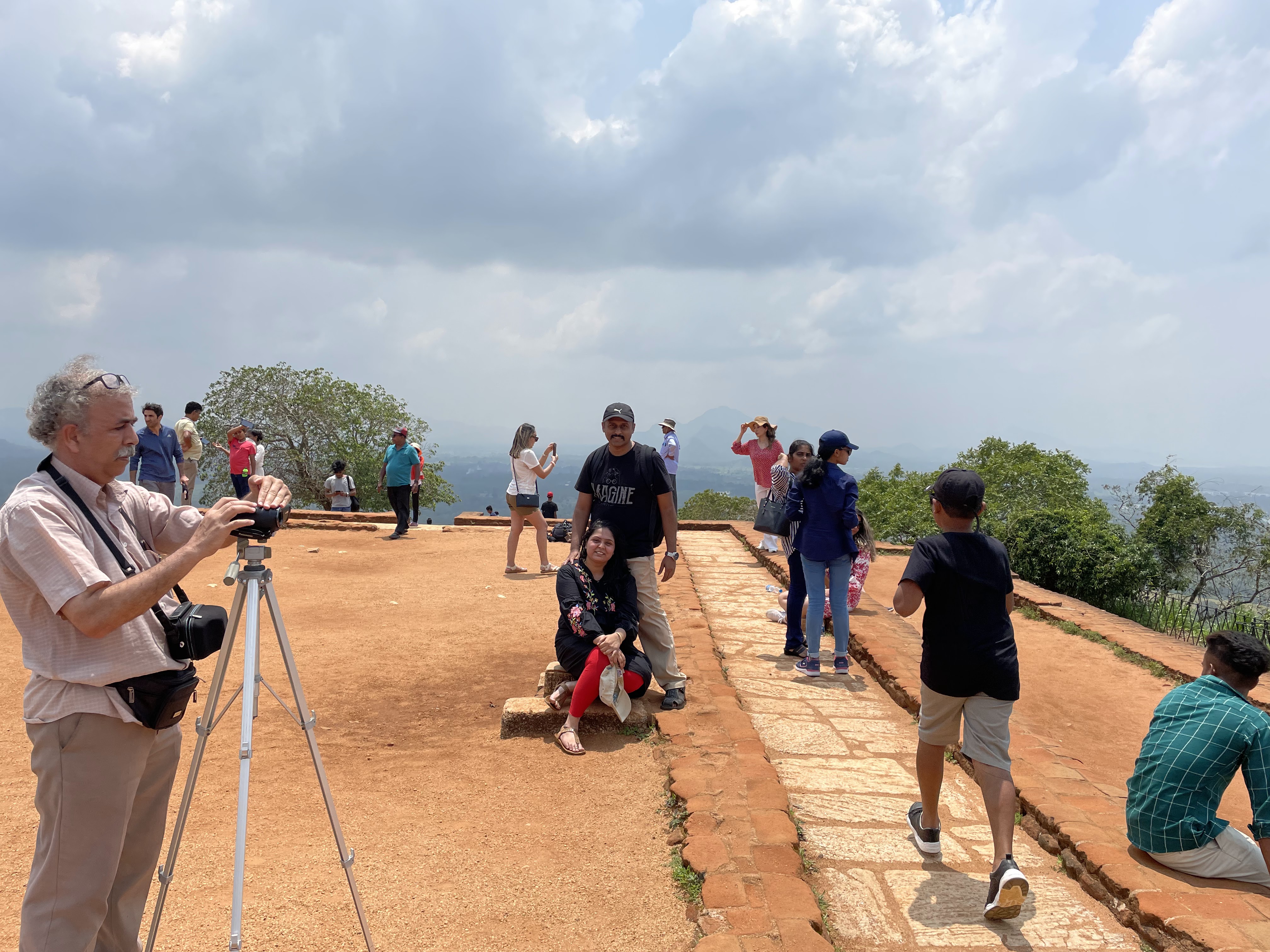
Sigiriya: This ancient rock fortress is one of the most iconic landmarks of Sri Lanka. It was built by King Kasyapa in the 5th century CE as his royal palace and capital. The site features a massive rock that rises 200 meters above the surrounding plains, with a palace complex on top and a series of gardens, ponds and frescoes at its base. Sigiriya is also known as the Lion Rock because of the huge lion-shaped gateway that leads to the summit. It is also said that Ravana's kingdom existed in & around this area. To go to the top, one needs to climb 1200+ steps, I reckon it's totally worth the effort. 

Spectacular view before the climb

Our guide of the day in Sigiriya

At the top

The climb

Yala National Park: This is the most visited and second largest national park in Sri Lanka. It covers an area of 979 square kilometers and hosts a variety of ecosystems such as forests, grasslands, wetlands and beaches. Yala is famous for its wildlife diversity and density, especially its large population of leopards. It is also home to elephants, crocodiles, sloth bears, deer, monkeys and many species of birds. Yala has the highest population density of leopards in the world, making it a great place to spot these elusive cats.

Elephant - most common sighting

Nuwara Eliya: This is a picturesque town in the heart of Sri Lanka’s tea country. The British colonial experience is strong as still retains its major influence in architecture. Nuwara Eliya is surrounded by green hills and tea plantations that produce some of the finest teas in the world. It is also a popular destination for hiking, golfing and enjoying the cool climate. We also witness Ashoka Vatika where Sita Devi was held captive by the demon King Ravana - there is a temple dedicated to Devi Sita.

The Culture of Sri Lanka

Sri Lanka is a melting pot of cultures that reflects its long and rich history. The country has been influenced by various civilizations and religions over the centuries, from ancient Buddhist kingdoms to colonial powers such as Portugal, Netherlands andc1 Britain. Today, Sri Lanka is a multi-ethnic and multi-religious society that celebrates its diversity and harmony. You can experience the different aspects of Sri Lankan culture by visiting its temples, mosques, churches and monuments that showcase its architectural and artistic heritage. You can also enjoy its vibrant festivals, music, dance and cuisine that reflect its unique blend of traditions and influences.

Some of the popular places we visited in Sri Lanka with a focus on its culture were:

Trincomalee: Trincomalee is a town and port in the Eastern Province of Sri Lanka and has a rich history and culture, dating back to over two millennia. It is home to the famous Koneswaram temple, which is one of the five abodes of Shiva and a major Hindu pilgrimage siteTrincomalee is also known for its beautiful beaches, such as Uppuveli and Nilaveli. Trincomalee is a hidden gem in Sri Lanka that offers a unique experience for travelers.

Kandy: This is the cultural capital of Sri Lanka and the last royal city of the Sinhalese kings. It is located in a scenic valley surrounded by hills and forests. Kandy is famous for its sacred Temple of the Tooth Relic , which houses a tooth believed to belong to Buddha himself. The temple is also the venue for the annual Esala Perahera festival , which is one of the most spectacular religious processions in Asia. It features thousands of dancers, drummers, elephants and torchbearers parading through the streets in honor of Buddha.

Galle: This is a historic port city on the southwest coast of Sri Lanka. It was founded by the Portuguese in the 16th century and later fortified by the Dutch in the 17th century. Galle is known for its well-preserved colonial architecture and atmosphere. The Galle Fort , which covers an area of 52 hectares , is a UNESCO World Heritage Site that contains many buildings from different eras. On the way from Galle to Colombo we would get the coastal city of Bentota where you could see a large chunck of European tourists because of availability of hosts of watersports. There is a spectacular watersport activity around mangroove forest where Madu river meets Indian ocean.

Colombo Colombo is a bustling and vibrant city that offers a mixture of modern life, colonial buildings and monuments, and natural beauty.  It has a rich and diverse history and culture, influenced by various colonial powers such as the Portuguese, Dutch and British, as well as the local Sinhalese and Tamil communities.

Conclusion - Whether you want to relax on the sand, explore the cultural heritage, or enjoy the thrill of adventure, Sri Lanka has something for everyone. Highly recommended.